In 2026, generic software is losing ground. Companies are moving away from all-in-one tools toward solutions tailored to a single business, increasingly powered by AI. Gartner expects 40% of enterprise applications to embed specialized AI agents by the end of 2026, up from less than 5% a year earlier. Vertical players like Sierra (customer service, valued at 15.8 billion dollars) and Harvey (legal, 300 million dollars in annual revenue) are raising staggering amounts on one simple promise: a tool that truly speaks your business beats a tool that speaks to everyone.
But for a business owner, the real question is not generic or specialized. It is renting someone else's vertical, or owning your own. Because the value no longer sits in the software. It sits in your data, your processes and your business rules. Here is how to read this shift, and how to decide between a vertical SaaS and a custom digital core.
Three terms, one sentence each:
- Horizontal SaaS: generic software that serves every sector (email, standard CRM, spreadsheet). Broad, but shallow on your business.
- Vertical SaaS (or vertical AI agent): software pre-loaded with the vocabulary, rules and integrations of one specific sector. Deep, but still owned by the vendor.
- Digital core: your own business platform, custom-built around your processes, that you own (code and data).
These three options are not mutually exclusive. Most companies will end up combining them. The trick is knowing what belongs in each box.
What is actually happening in 2026?
The shift is measurable. The vertical SaaS market is growing at roughly 24% per year, nearly double the pace of SaaS overall. Vertical vendors post revenue retention rates of 91 to 96%, while horizontal platforms serving SMBs lose 31 to 58% of their customers every year. The reason is mundane: when a tool fits the business, you stop leaving it. When it stays generic, you drop it the moment a better-fitting competitor shows up.
AI accelerates the movement. A vertical agent is not a general-purpose chatbot. It is pre-fed with sector knowledge, compliance rules, business-specific data models and deep integrations. Sierra charges per resolved ticket, not per seat. Harvey trains on the contract archives of the firms it serves. Where a horizontal tool waits for you to explain your context on every request, the vertical tool already knows it.
A word of caution, though. The wave attracts opportunists: many vendors rebrand an old SaaS with a bolted-on chatbot as a "vertical agent". The right question is not "do you have AI?", but "which of my business data does your agent act on, and who owns it?". The answer to that question separates marketing from substance.
Why generic software hits a ceiling?
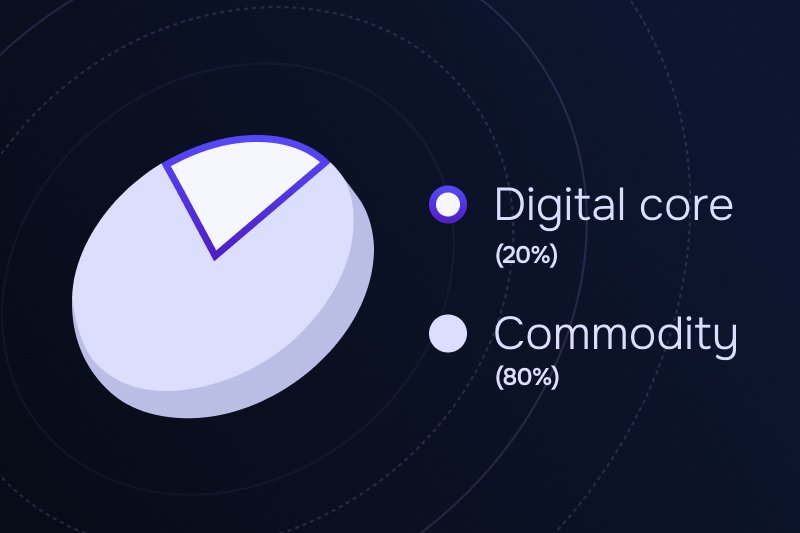
Every business has its irreducible 20%. The remaining 80% (invoicing, scheduling, messaging) is commodity: standard software covers it very well. But the 20% that makes your difference, the way you qualify a case, sequence your steps, apply your rules, no generic tool covers without contortions. You end up bending your business to fit the tool, instead of the tool serving the business.
AI does not solve this on its own. It amplifies it, either way. Placed on fuzzy processes and messy data, it speeds up the mess. Placed on a structured foundation, it multiplies its value. This is our founding principle at KERN-IT: development starts before the code. You build the core first (data, processes, rules), then you lay AI on top. Not the other way around.
Where did the value go?
Here is the point that vertical SaaS vendors do not advertise. The analysts who study these players agree on one thing: their real competitive edge is not the AI model underneath (often the same Claude or GPT as everyone else). It is the accumulated business depth: the permissioned dataset, the integrations, the codified procedures. Thousands of hours of sector knowledge, encoded.
But that depth, in your case, is yours. Your data, your processes, your rules. So the question becomes: who owns that moat? If you adopt a vertical SaaS, you enrich the vendor's moat with your own material. The day you leave, you take your raw data (if the contract allows), but not the intelligence built around it. If you build your digital core, that moat is yours, it grows with you, and it cannot raise its price by 14% every year or shut down after an acquisition.
So the debate is not horizontal versus vertical. It is renting someone else's intelligence, or capitalizing your own.
Comparison: horizontal SaaS, vertical SaaS, digital core
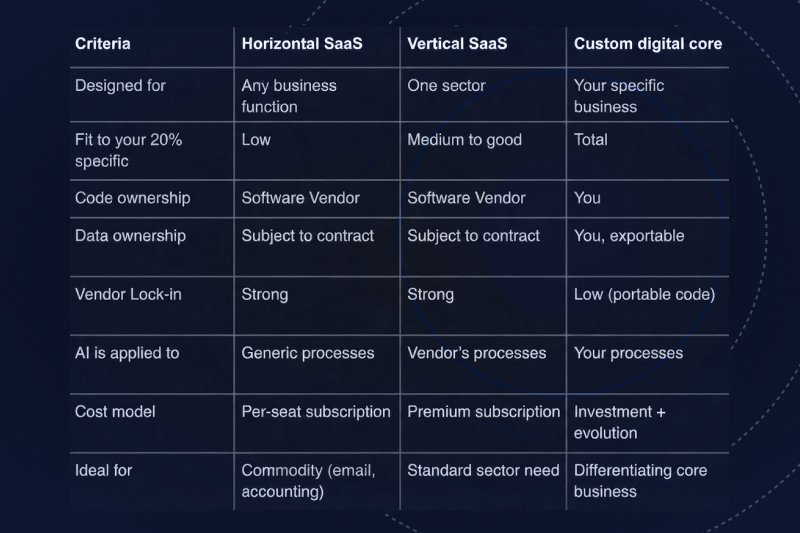
No column is bad. They answer different needs, at different moments. The trap would be to believe you must pick a single column for the whole company.
The real architecture is not binary
In practice, you do not replace everything with a digital core, and you do not just pile up subscriptions either. You compose. Commodity stays on standard SaaS (accounting, payroll, email). The core business lives in your platform. And the two talk to each other.
This is our core stance: we augment, we do not replace. We do not rebuild your ERP or your accounting. We build the 20% that standard software will never cover, connect it to your existing tools, and leave you full ownership.
AI makes this composition simpler than before. The Model Context Protocol (MCP), adopted in 2026 by all major models, is becoming the USB-C of AI: a standard that lets an agent plug cleanly into software without custom re-integration every time. A well-designed digital core exposes it. The result: your agents (and tomorrow's, whatever they are) act on your data, by your rules, without locking you into one particular AI provider. You keep control of the foundation and stay free to choose the brain you place on top.
The digital core: the vertical you own
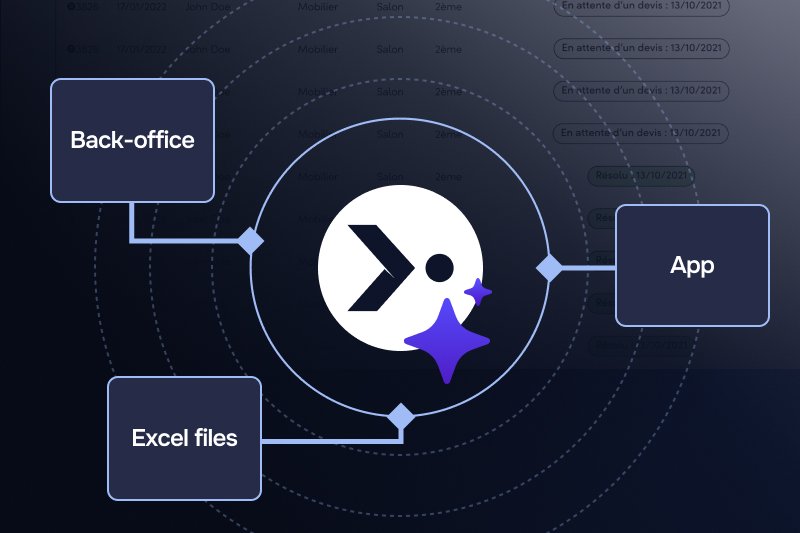
A digital core is the operating system of your business. Not a website, not just a tool: the platform that encodes your structured data, your processes and your rules, on which your interfaces plug in (management back-office, mobile app, public portal) and, when the time comes, your AI layer.
A concrete example. A distributor managing stock across spreadsheets and three stacked SaaS tools always hits the same wall: none of those tools knows its in-house allocation rule, the one that decides which batch goes to which client based on its own priorities. A generic SaaS does not handle it. A vertical SaaS handles it its way, not yours. The digital core, on the other hand, encodes that rule once and for all, puts it at the center, and leaves accounting to the standard tools. That is exactly what we did with a custom stock management platform, or by turning an unmanageable spreadsheet into a durable business foundation.
The advantage in the AI era is direct. An agent placed on your digital core acts on your data, in your language, by your rules. It does not guess your context: it has it in front of it. And it works for a moat that belongs to you.
5 questions to decide
Before choosing between adopting a tool and building your own, run the subject through these five questions. As soon as one tips toward the high end, the custom digital core takes the lead.
- Criticality. If this tool goes down, what do you lose? A few minutes, or revenue and reputation? The more critical, the more control matters.
- Specificity. Does your way of doing things set you apart from competitors, or is it standard in your sector? A differentiator deserves to be encoded in-house.
- Data. Do you handle sensitive data (personal, financial, strategic) that you do not want feeding a vendor's moat?
- Lifespan. Should this tool live three months or ten years? Over time, renting costs, ownership compounds.
- Ownership. Do you need to own the code and evolve the tool at your own pace, without depending on a third party's roadmap?
If your answers trend low (not critical, standard, ordinary data, short term, no need to own), a SaaS is enough, and over-building would be a mistake. If they trend high, you are on your core business: that is where custom pays off.
An order of magnitude: rent forever or invest once
The math is worth doing, even roughly. Take twenty users on a vertical SaaS at 80 euros per month: about 19,000 euros per year, without owning anything. Software inflation runs at 11 to 14% per year, so over three years the cumulative bill comfortably exceeds 60,000 euros, and it never stops. A business digital core is built in that same order of magnitude, once, plus a controlled ongoing evolution, and you own it.
This is not a quote, it is an order of magnitude to frame the thinking. The tipping point depends on the number of users, criticality and lifespan. But the logic is constant: the more central, populated and durable the tool, the more expensive renting becomes against owning. It is also why custom software without maintenance loses value: an asset needs upkeep.
When a SaaS (horizontal or vertical) is the right call
Building your digital core only makes sense for what sets you apart. For everything else, SaaS is the right choice, and over-building would be the mirror mistake.
Stay on a standard tool when:
- It is commodity. Messaging, accounting, e-signature, video calls: no one wins by reinventing these.
- A vertical SaaS already covers your sector well without a specificity that truly sets you apart, and you accept its model and its dependency. That is a legitimate choice, made with eyes open on ownership.
- You want to validate first. To test an idea, a fast prototype in no-code or vibe coding is unbeatable, as long as you treat it as disposable.
You move to the custom digital core when the subject becomes critical, data-sensitive, durable, or central to what makes your value. That is where ownership and fine-tuning stop being a luxury.
FAQ
What is a vertical AI agent? An AI agent built for a single business or workflow, pre-loaded with sector knowledge, compliance rules, data models and integrations specific to that sector, unlike general-purpose horizontal agents (ChatGPT, Claude, Copilot) that depend on what the user explains.
What is the difference between horizontal and vertical SaaS? Horizontal SaaS serves every sector with general features. Vertical SaaS is tailored to one sector, speaking its vocabulary and respecting its rules. Vertical retains customers better (91 to 96% retention) but remains, like horizontal, the vendor's property.
Are vertical SaaS and a digital core mutually exclusive? No. Most companies combine standard SaaS for commodity (accounting, payroll, email) and a digital core for the differentiating core business, with the two connected. The question is not which to pick for everything, but what to put in which box.
Will a vertical SaaS replace my custom business software? For your standard processes, a vertical SaaS can be enough. For what truly sets you apart, no: it makes you fit the vendor's model. The real alternative to custom is the trade-off between business fit and ownership, and a digital core gives you both.
What is a digital core? The operating system of your business: a custom platform that structures your data, processes and rules, on which your interfaces and your AI plug in, and of which you keep full ownership (code and data).
What does MCP change for my business software? The Model Context Protocol is a standard, adopted in 2026 by all major AI models, that lets an agent connect cleanly to software. A digital core that exposes an MCP lets your agents act on your data without custom re-integration, and without locking you into a single AI provider.
Do I own my digital core and my data? Yes. At KERN-IT, the code and data remain your property, exportable and portable, unlike a SaaS subscription where the platform and the intelligence built around your data belong to the vendor.
How much does a digital core cost compared to a SaaS subscription? A SaaS subscription is a recurring per-user cost, rising 11 to 14% per year on average. A digital core is an investment at build time (in the order of a few tens of thousands of euros for a business platform), then ongoing evolution. The math tips when users multiply or the tool becomes critical.
Let's talk about your core business
The vertical-agent trend gets one thing right: generic is no longer enough where your business is decided. What remains is to choose what you want to own, and what you accept to rent.
If you are torn between adopting specialized software and building your own platform, a scoping workshop is often enough to decide: we map your differentiating 20%, identify what is commodity, and cost out both paths. Let's talk about your project.