AI did not change the nature of companies.
It just made their state more visible. And faster.
If your company is in chaos, AI will accelerate the chaos. If it is in order, AI will accelerate the order. Anything else is marketing talk.
At KERN-IT, we have spent ten years helping companies add intelligence to their operations. One thing comes up every time: before talking about AI, you need to talk about the foundation you are going to set it on.
Here is the structure we ended up formalising after ten years of practice. Five levels of digital core. Five levels of digital brain. And one rule that allows no exceptions: no brain is possible without a core underneath.
AI accelerates your initial state
Here is a scenario we see regularly.
A mid-size company has ten unsynchronised Excel spreadsheets. Three different CRMs depending on the department. Processes documented nowhere. Customer data that contradicts itself from one tool to another.
This company decides to "add AI". It buys a ChatGPT Enterprise subscription. It pushes its data in.
What happens?
The AI gives contradictory answers at high speed. Salespeople see one version. Support sees another. Accounting sees a third. Nobody knows which one is right, but everyone now has the confidence of an assistant that replies in two seconds.
AI did not create anything. It just amplified the existing chaos.
Now take a company that has done the work. Data centralised in a single business platform. Processes documented semantically (a "customer" means the same thing everywhere). Workflows automated. When this company adds AI, it gets real leverage: what worked well works even better, at a larger scale.
AI did not create the order. It amplified it.
The lesson: AI is not a shortcut. It is an amplifier. Choose what you want to amplify.
The digital core: five foundation levels
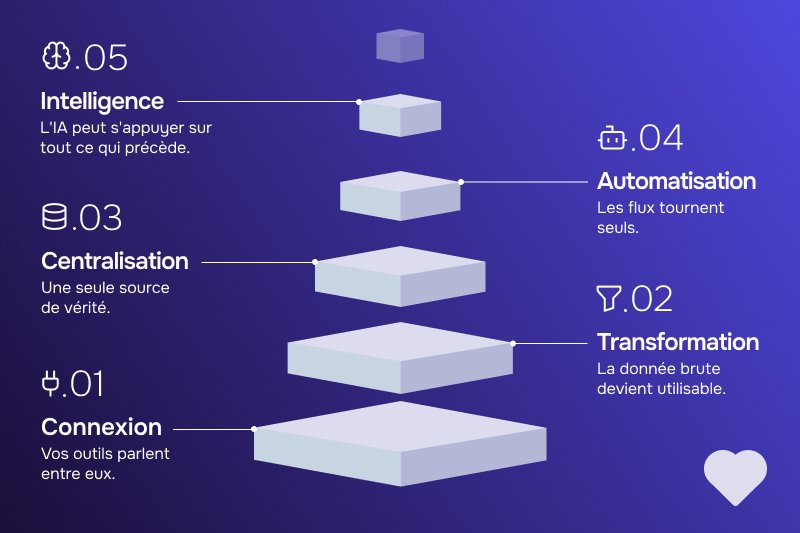
The digital core is the operational infrastructure that makes your business executable. It is what we have been building for our clients for ten years. It is what you need to build before thinking about AI.
Five levels, in this order.
1. Connection
Your tools talk to each other.
Your CRM can send an update to your invoicing software. Your website creates a customer record in your back office. Your scheduling tool reads from your stock. APIs, webhooks, integrations are in place. No more manual copy-paste between two screens.
This is the first level. Without connection, you stay in silos. This is also the subject of our article on Odoo, when you give it its proper place: an ERP is useful when it is correctly connected, not when it tries to absorb everything.
2. Transformation
Raw data becomes usable.
When your supplier sends you a non-normalised Excel, your system cleans it, structures it, translates it into your business language. Customer names are harmonised. Units are uniform. Duplicates are resolved. The business semantics emerge.
This is the step most often skipped. It is also the one that decides the quality of everything that comes next. If your data is dirty, your AI will have dirty answers.
3. Centralisation
A single source of truth. A single place where information officially exists.
No more debate over "who is right between Pierre's file and Marie's". Data lives in a single business platform, accessible to those who need access, with a change log, access rights, and one version that prevails.
This is the step that transforms a company "running on Excel" into a company that can actually scale.
4. Automatisation
Flows run on their own.
A customer signs a quote? Your system creates the invoice, schedules the first intervention, sends the welcome email, updates the sales pipeline. Without a human having to step in between each phase.
The human does not disappear. They move from bottleneck to supervisor. They decide, they validate, they handle the exception. The rest happens without them.
This is the level where a company starts being able to scale its activity without scaling its headcount proportionally. This is the focus of our centralization and automation landing page.
5. Intelligence
AI can rely on everything that came before.
Now that your data is connected, transformed, centralised and automated, AI has something to feed on. It can reason on consistent facts. It can act in systems that do not lie to it. It can make decisions that make sense because the foundations are sound.
Without levels 1 to 4, this top floor collapses. It really is that simple.
The digital brain: five levels of intelligence
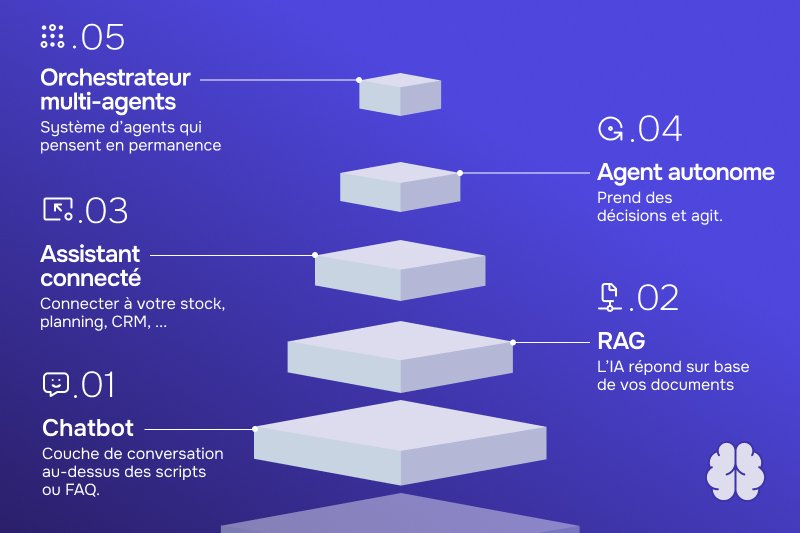
Now that we have the core, let us talk about the brain. AI is not a single layer. It is a gradient with its own stack.
1. Chatbot
A conversation layer over scripts or FAQs.
Useful for automating simple interactions: qualifying a prospect, answering a recurring question, routing a client to the right team. Low cost, low value, but disappointing fast if you expect more.
Required core level: 1-2 is enough. A chatbot can live on a site connected to your CRM, no more.
2. RAG
Retrieval Augmented Generation. The AI answers using your documentation, not what it learned during pre-training.
Your model draws from your knowledge base to formulate answers grounded in your real content. Ideal for product documentation, an internal knowledge base, an assistant that explains your procedures.
Required core level: 2-3. Your documentation must be transformed (cleaned, structured) and centralised. If it lives in 30 scattered Word files, RAG will answer poorly.
3. Connected assistant
The sweet spot for most SMBs in 2026.
The AI does RAG and can query your APIs in read mode to get fresh data: your CRM, your stock, your scheduling. It prepares answers, draft emails, draft actions. You validate before execution.
The human stays in the loop. This is what makes the system safe in production: it accelerates without deciding on its own.
Required core level: 3-4. Centralisation is essential, automation at least partial so that readable APIs exist.
4. Autonomous agent
An AI agent makes decisions and acts in your systems. It chains multiple tools, plans its steps, executes without human validation at every step.
This is what Meet AMA is, our internal AI agent at KERN-IT. It checks our timesheets, writes in Discord, prepares analyses, triggers follow-ups. And it has the right to be wrong, because we accept the risk on ourselves before offering it to a client.
Required core level: 4-5. Without solid automation underneath, an agent acting autonomously becomes an agent breaking things autonomously.
5. 24/7 multi-agent orchestrator
The real digital brain of the company.
Several specialised agents run continuously, without human prompting. An SDR agent qualifies leads in the background. A support agent handles simple requests. A compliance agent watches transactions. An accounting agent reconciles invoices. An orchestrator agent supervises and delegates.
These are no longer tools you query. They are a system that thinks continuously for the company. It does not sleep. It does not take a break. It alerts only when a human must decide.
Required core level: 5 complete. The whole pyramid built, solid, supervised. Otherwise, the orchestrator only amplifies chaos at the speed of 24/7 execution.
This is the territory our internal lab is exploring today. What our clients will want in eighteen months.
Now that the grid is clear, the explanation for failures becomes obvious.
Most companies launching into AI try to build the brain before the core. They start with an ambitious agent or orchestrator, when they have not even centralised their data or automated their basic flows.
Result:
- The AI POC is impressive in the demo. It draws from data hand-curated for the occasion.
- In production, the agent meets real chaotic data. It hallucinates. It makes decisions on false premises.
- The team discovers that to fix the AI, they first have to fix all the infrastructure underneath.
- The AI budget balloons to do the work that should have been done before.
- The project is paused. Often abandoned.
The trap is not AI. The trap is believing that AI will replace the foundation work. It does not replace it. It presupposes it.
This idea is not new. In fact, it is a principle we illustrate in our article on Maslow’s law applied to technology: to a man with a hammer, everything looks like a nail. To someone who thinks only of AI, every missing foundation looks like a feature to be coded.
The honest test: where are you on the pyramid?

Five questions to situate your maturity, without cheating.
Do your tools talk to each other in real time, or via manual CSV export? If you are still exporting by hand, you are below core level 1.
Do you have a single source for your customer data? If three departments each have their own version, you are below core level 3.
How many times a day does someone copy-paste from one tool to another? More than five, you are below core level 4.
What share of your critical processes runs without human intervention? Less than 30%, you are at core level 3 or below.
Is your data documented semantically? Does a "customer" in one tool mean the same thing in all the others? If not, you are still at core level 2.
If you are at level 2 or 3, do not try to climb to brain level 4 or 5. You will burn your budget and your energy. Build your core one step further first. The return on investment is immediate.
Our approach at KERN-IT
We do not sell AI. We sell digital core and have done so for ten years.
Our clients often come asking for "an AI project". We almost always start by looking at what they have underneath. When the core is solid, AI adds on naturally. When the core is fragile, we propose consolidating it first.
This is not a sales pitch. It is a question of operational efficiency for the client.
A few milestones from our own practice:
- Meet AMA, our internal AI agent, is at brain level 4. It works because we built our own digital core across the five levels. We eat our own dog food.
- Our internal lab is exploring brain level 5 (multi-agent orchestrators) because that is where the next wave will play out. We want to be ready when our clients are ready.
- Our custom business platforms (IKOMOB for stock and project management, VENN ERP for telecom, and others) are designed to be AI future-proof: modern architecture, clean APIs, explicit business semantics. The core we build today is meant to host the brain of tomorrow.
That is our craft. It is also our conviction: you do not run before you walk.
Recurring questions
Do we really need to climb the whole pyramid before AI?
Not wait, no. But do not confuse the levels. If you are at core level 2, climb to 3 and 4 before attempting an autonomous agent. On the other hand, a simple chatbot (brain level 1) can run on a partial core. It is all about coherence between the two pyramids.
How long to climb each level of the core?
Variable depending on starting maturity and company size. As a rough indicator, going from level 2 to level 3 (centralising business data) typically takes six to twelve months in an SMB. It is an investment, not an expense.
Can you build the core and the brain in parallel?
Yes, provided you calibrate the brain to the current level of the core. Launching a chatbot while you build out centralisation is healthy. Launching an autonomous agent before centralising is a guaranteed failure.
What is the ROI of an additional core level?
Concrete. Centralisation = end of contradictions between departments, time saved searching for information. Automation = capacity to scale your activity without scaling headcount proportionally. The ROI of one core level is often higher than the ROI of a poorly framed AI project.
How do we know where we are on the pyramid?
The five test questions above give a quick diagnostic. For a finer evaluation, we offer a short audit (a few days) that maps the current state of your digital core and identifies the next level to climb. It is often the best entry point into a KERN-IT relationship.
In conclusion
AI is not a shortcut. It is an amplifier.
If your company is in chaos, AI will accelerate the chaos. If it is in order, AI will accelerate the order.
The work that matters happens before AI. Five core levels: connection, transformation, centralisation, automation, intelligence. When the core is solid, the brain can emerge. Not before.
At KERN-IT, we have been building this core for more than ten years. For startups and Belgian and European SMBs that have understood you do not skip the steps.
If that sounds like your situation, you know where to find us.