In short: Dev Team Simulator is a free online serious game that puts you in the shoes of a software project manager. You’ll make all the critical decisions: choosing the tech stack, hiring, budget management, and deadline trade-offs. Designed as an educational tool, it translates eight fundamental laws of software engineering (Brooks, Conway, Parkinson, Hofstadter, Goodhart, and three AI/vibe-coding dynamics) into game mechanics. A session takes between 5 and 20 minutes, making it perfect for training, onboarding, or self-paced learning.
Why a serious game for IT management?
In the world of software development, best practices are well-known, documented, and have been taught for decades. Brooks’ Law dates back to 1975. Conway’s Law, to 1968. And yet, the same mistakes are repeated project after project: adding developers to catch up on a delay, launching an MVP without a product owner, or pushing the team to maximum velocity until a collective burnout occurs.
Why? Because there is a well-documented gap between knowing and doing. A manager can be familiar with Brooks’ Law and still keep hiring under pressure. A team can read dozens of articles on technical debt and still choose to ignore it.
Serious games, or educational games, are a proven solution to this gap. By putting learners in the driver’s seat and showing them the direct consequences of their choices, they transform abstract knowledge into an embodied experience. This is the same principle behind business games in business schools, flight simulators for pilots, and crisis management drills for senior executives.
Dev Team Simulator applies this logic to software project management.
What is Dev Team Simulator?
Dev Team Simulator is a free, web-based management game where the player takes charge of a software project over several months. Two scenarios are available: digitizing an SME for a dev shop, or launching your own SaaS as a solo founder.
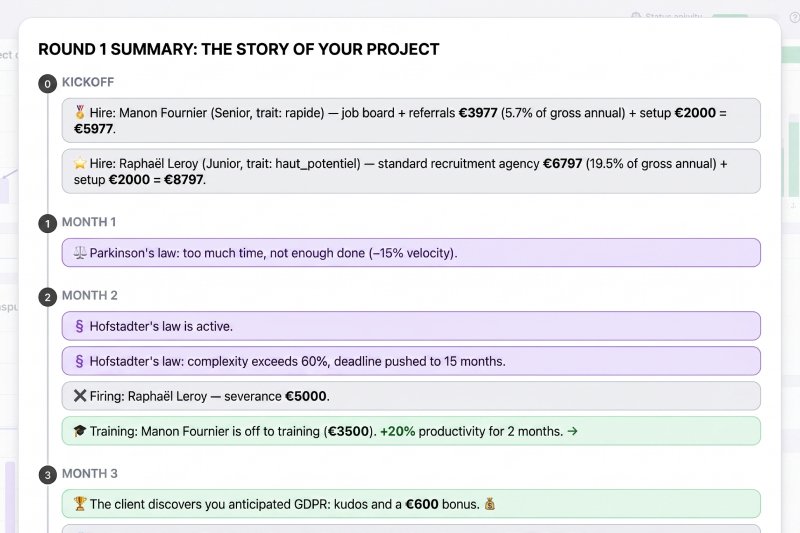
Each turn represents one month, during which the player makes management decisions: hiring, training, time off, technical trade-offs, compliance management, and responding to unexpected issues. While random events challenge your roadmap, the fundamental laws of software engineering remain in constant effect, regardless of whether you've planned for them.
At the end of the game, the project is scored out of 1,000 points across five dimensions: deadline, budget, code quality, regulatory compliance, and team health. A final grade concludes the experience: Mastered, Acceptable, Difficult, or Failure.
The tool was designed and developed by KERN-IT, a team specializing in software development and IT project management.
Who is this educational tool for?
Dev Team Simulator is designed for several professional audiences.
For founders and leaders, it makes technical trade-offs accessible without requiring a prior technical background.
For trainers and schools, it serves as a practical teaching aid for software engineering laws, Agile methods, and IT project management. A session can be played as a group, followed by a debriefing where each decision is discussed collectively. It is an effective complement to traditional theoretical materials.
For HR and L&D managers, it serves as an onboarding module for new technical leads or a tool to assess management reflexes during the hiring process.
For project managers and lead developers, it offers a zero-cost testing ground. Testing an aggressive hiring strategy, comparing the consequences of a vibe-coding stack versus a traditional one, or simulating a GDPR crisis without risking a real project: these are all scenarios that would be costly to test in real-world conditions.
Eight software engineering laws integrated into the game mechanics
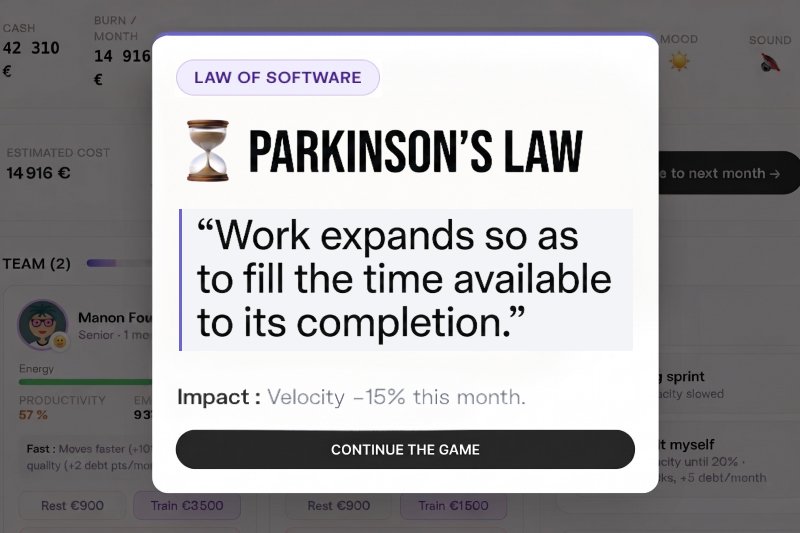
The educational core of the simulator is built on eight mechanics implemented in the code and triggered automatically based on the player’s decisions.
What is Brooks’ Law?
Brooks’ Law, formulated by Frederick Brooks in The Mythical Man-Month (1975), states that adding manpower to a late software project only makes it later. The reason lies in the number of communication channels between team members, which grows according to the formula n × (n−1) / 2— significantly faster than the team’s actual velocity.
In the simulator, every hire beyond a certain threshold mechanically adds complexity. A product manager or a developer with strong communication skills can soften this impact.
Qu'est-ce que la loi de Conway ?
Formulée par Melvin Conway en 1968, la loi de Conway postule que les organisations conçoivent des systèmes qui répliquent leur propre structure de communication. Sans coordination produit explicite, l'équipe finit par produire un logiciel qui reflète son organigramme plutôt que les besoins utilisateurs.
Dans le jeu, une équipe sans PM ni PO subit une pénalité de vélocité tant qu'aucune fonction de coordination produit n'est en place.
What is Conway’s Law?
Parkinson’s Law, formulated by Cyril Northcote Parkinson in 1955, observes that work expands so as to fill the time available for its completion. A distant deadline combined with sluggish progress naturally causes the team to slow down.
The simulator applies this penalty as soon as the ratio of time remaining to progress achieved exceeds a certain threshold.
What is Hofstadter’s Law?
Hofstadter’s Law, popularized in Gödel, Escher, Bach (1979), states that everything always takes longer than you expect, even when you take into account Hofstadter’s Law. Once a certain threshold of complexity is reached, initial estimates inevitably collapse.
In the game, as soon as complexity exceeds 60%, the deadline is automatically extended by 20%.
What is Goodhart’s Law?
Formulated by Charles Goodhart in 1975, this law states that when a measure becomes a target, it ceases to be a good measure. Pushing velocity to the limit creates apparent velocity, but destroys the underlying quality.
The simulation punishes three straight months of redlining with a massive technical debt spike and a velocity crash in the following turn.
Three dynamics unique to modern stacks
Three additional mechanics cover contemporary challenges involving AI and vibecoding.
AI Amnesia models the progressive loss of fundamental skills among junior and intermediate developers who rely on AI without oversight from an AI Engineer.
The Scaling Wall, specific to vibecoding, reflects the impossibility of scaling automatically generated code beyond a certain complexity threshold.
Invisible Debt, also unique to vibecoding, models the silent accumulation of technical debt within code that appears clean on the surface.
How does the game work?
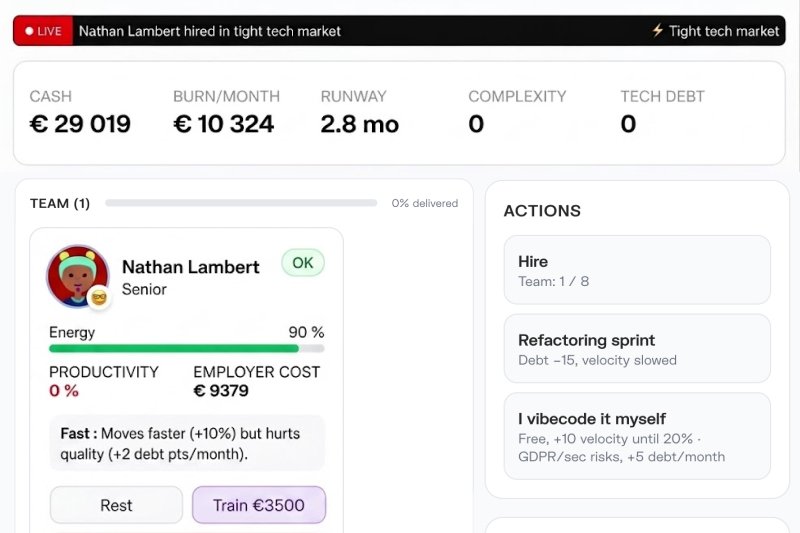
A typical game follows five stages.
Step 1: Scenario selection. Choose between a dev shop working for an SME client or a solo founder bootstrapping a SaaS. Each scenario sets the budget, deadline, and initial constraints.
Step 2: Choosing the tech stack. Traditional code, AI-augmented, or vibecoding. Three different philosophies, each with its own strengths and respective glass ceilings.
Step 3: Team composition. Recruit from about a dozen profiles: juniors, mids, seniors, product managers, product owners, DevOps, QA, AI Engineers, freelancers, or external outsourcing.
Step 4: Month-by-month gameplay. Each turn, the player must balance velocity, quality, team energy, compliance, and cash flow. Random events are thrown into the mix to spice things up.
Step 5: Final score and debriefing. Rating out of 1,000 points, grade letter, and a shareable scorecard.
How to integrate Dev Team Simulator into a training program?
Several educational use cases are possible depending on the context.
In initial training, the simulator can serve as a common thread for a half-day session. Students play an initial round independently, followed by the instructor explaining the eight laws based on the group's choices. The debrief becomes tangible because it focuses on decisions they actually experienced.
For continuing education, the tool is ideal for one- to two-hour workshops for technical managers. It offers a short format, immediate immersion, and collective debriefing on strategic trade-offs.
During onboarding, it speeds up the ramp-up of new lead developers or product managers by giving them a fast-tracked experience of the project dynamics they will have to manage.
For self-paced learning, it serves as an individual sandbox to test various strategies without any real-world consequences.
Common Questions
Is Dev Team Simulator free? Yes. The tool is completely free of charge, accessible via browser, with no registration required.
How long does a session last? Between five and twenty minutes, depending on the chosen scenario and your playing speed.
Do you need to be a developer to play? No. The simulator is accessible to anyone interested in IT project management, whether you are a developer, manager, trainer, student, or lead.
Can the game be used in a classroom or for training? Yes. It is explicitly designed as an educational tool. Instructors are free to use it as a supplement to their courses on software project management, Agile methodologies, or the laws of software engineering.
Are the laws represented in the game faithful to the literature? Yes. The eight implemented mechanisms are based on principles documented over several decades in software engineering literature (Brooks 1975, Conway 1968, Parkinson 1955, Hofstadter 1979, Goodhart 1975), as well as three contemporary dynamics related to AI and vibecoding.
Can I share my score? Yes. At the end of each session, a visual card is generated, ready to be shared on LinkedIn or any other social network, along with a permalink allowing others to explore the details.
Who is behind Dev Team Simulator? The tool was designed and developed by KERN-IT, a team specializing in software development and IT project management consulting.
Taking it further
A serious game is no replacement for field experience. However, it compresses certain lessons into a few minutes and transforms abstract concepts into concrete memories. This is exactly what we aimed to build with Dev Team Simulator: a free educational tool that is serious in substance, playful in form, and equally useful for trainers and managers looking to challenge their own instincts.
👉Start a game at magnet.kern-it.be
Are you a trainer, educational institution, or organization wanting to incorporate Dev Team Simulator into a learning path?Contact the KERN-IT teamwe would be delighted to discuss the various ways you can use it.