Turning Excel into a platform: The first real step in your digitalization
By Khalid Yagoubi - Publication : 04 Dec, 2025
6 min read

Does your business run on Excel?
Excellent. It’s the sign that you’re ready for the next level.
At KERN IT, we have guided many companies through their digital transformation.
And we’ve noticed a common thread: in the majority of cases, the operational core relies on a spreadsheet.
Orders, inventory, scheduling, reporting, HR, production tracking…
It all ends up in an Excel, Google Sheets, or Airtable file.
And contrary to popular belief, that’s not a problem.
In fact, it’s an excellent sign of maturity.
When we talk about Excel, we mean any tabular tool
When we say 'Excel,' we are actually referring to any tabular tool:
- Microsoft Excel
- Google Sheets
- LibreOffice Calc
- or, for more advanced users, Airtable, Notion Tables, and Smartsheet
These tools embody a healthy instinct: structuring your business logic.
They translate your operations, data, and rules into a universal language: rows and columns.
Often, these are the first prototypes of a future application; scrappy, but deeply representative of field reality.
Ces outils incarnent un même réflexe sain : structurer votre logique métier.
Ils traduisent vos opérations, vos données et vos règles dans un langage universel : les lignes et les colonnes.
Souvent, ce sont les premiers prototypes d’une future application, bricolés, mais déjà très représentatifs de la réalité du terrain.
💡If you can describe your business in a clear table, you are already ready to digitalize it.
Excel: The mirror of your organization
Excel (or Sheets, or Airtable) reveals your internal model:
- Your implicit business rules
- Your inter-departmental dependencies
- Your key performance indicators (KPIs)
At KERN IT, we often start with these files.
They contain the reality of your operations, often more accurately than any formal specification.
Excel is not an obstacle; it’s a living prototype of your future digital system.
And what if you don’t even have Excel?
Some companies aren't there yet: information flows through emails, WhatsApp, notebooks, or stays in employees' heads.
This isn't a weakness; it's often a sign of rapid, intuitive growth.
But as long as your data is not formalized, it cannot be automated.
That’s where KERN IT comes in:
- Mapping your processes
- Identifying your key data
- Defining rules and dependencies
- Translating it all into a table or visual prototype
If you don’t have your 'Excel' yet, we help you build it; not to keep it, but to use it as the first building block of your future digital system.
The limits of Excel: when growth outpaces the spreadsheet
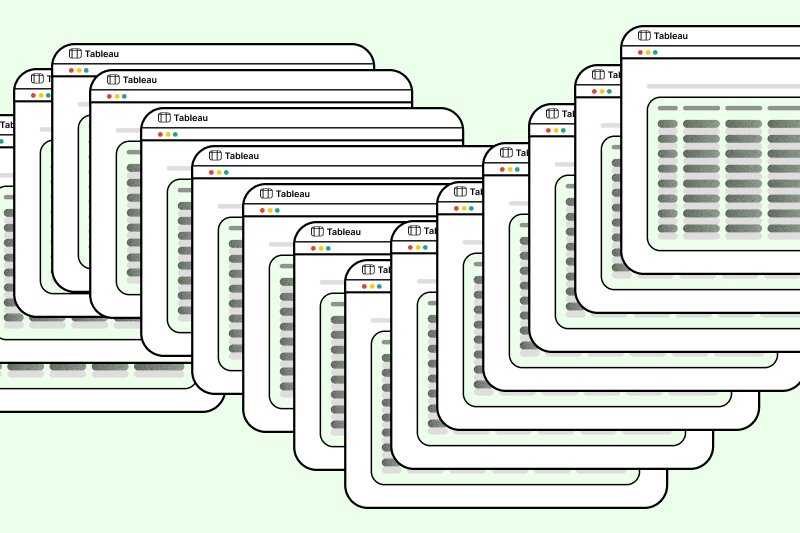
What makes Excel a strength on a small scale quickly becomes a liability:
- Multiple versions
- Data entry errors
- Lack of traceability
- Slow performance and dependency on a single person
- Lack of real-time collaboration
- Risk of file corruption
The company ends up revolving around the file instead of its processes.
That’s the moment to take a leap: moving from a DIY tool to a centralized, sustainable, and scalable system.
Turning Excel into an application: A performance driver
At KERN IT, we transform your Excel, Google Sheets, or Airtable files into custom web applications, perfectly aligned with your business reality.
The goal is to extend your expertise into a more robust environment:
- Centralization: All your data in one place.
- Automation: Reduction or elimination of manual entry and human error.
- Security: Permission management, traceability, and backups.
- Scalability: A foundation capable of growing with your business.
Our tools evolve with your growth, Lego brick by Lego brick.
Each new piece reinforces the previous one, without breaking what’s already there.
What if you already have tools in place?
You might already be using a CRM like HubSpot, Salesforce, or Zoho; an ERP like Odoo, SAP Business One, or Microsoft Dynamics 365; or solutions like Monday, Asana, or Jira.
On paper, you are digitalized.
But in practice, these tools don’t always talk to each other.
Sales logs the data, accounting re-enters it, and reporting is still done by hand.
That’s exactly where KERN IT comes in: we develop digital cores that connect, orchestrate, and unify your existing tools.
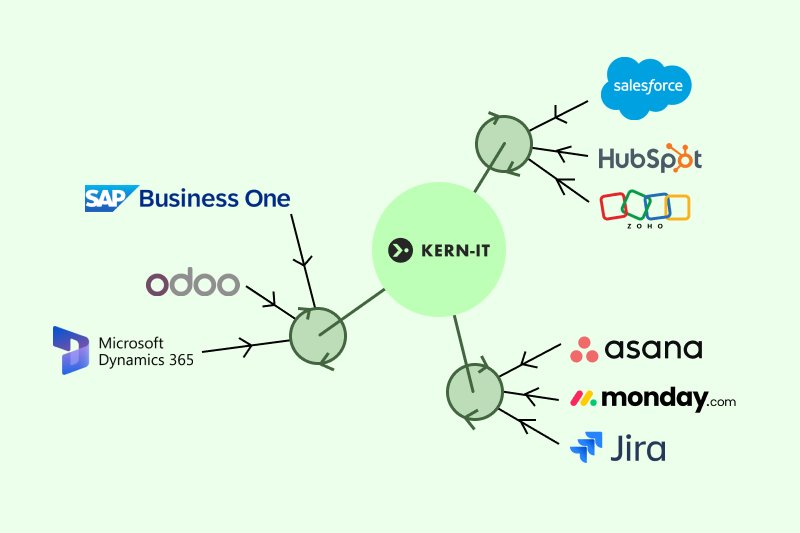
The digital core: The nervous system of your company
A digital core is the missing piece between your tools.
It is what:
- Synchronizes flows between your systems
- Centralizes critical data
- Automates recurring actions
- Ensures a global and reliable view of your business activity
It’s the difference between 'having multiple tools' and 'having an integrated system.'
Digital Maturity: From spreadsheets to the digital core
We distinguish four key stages:
- Artisanal Organization: Everything relies on simple tools (spreadsheets, emails)
- Local Automation: A few isolated automations are in place.
- Digital Core: KERN IT designs and develops the platform that connects your services and data, the nerve center of your information system.
- Augmented Intelligence: Data becomes a lever for decision-making, analysis, and foresight.
Our mission: to support you at every stage, without skipping a single step.
To digitalize is, first and foremost, to understand
Too many companies want to automate without understanding their processes.
The result: ill-suited tools, costly projects, and confused teams.
At KERN IT, our principle is simple:
You can't digitalize a blur: you structure it first.
Before coding, we analyze how you operate, clarify your rules, and model your workflows.
This analytical groundwork is what guarantees a project’s success and longevity.
The right time to switch to an application
Automation makes sense when volume, frequency, or the risk of error justifies it.
Custom development is a performance investment: fewer errors, less wasted time, more control, and more value.
Common pitfalls to avoid
Common Pitfalls:
- Trying to automate everything at once
- Believing an off-the-shelf tool will adapt itself
- Neglecting data quality
- Forgetting the human element
Our method: stabilize, prototype, validate, and then automate.
A successful digitalization is always preceded by a thorough understanding.
The human element
Digitalization isn’t about replacing teams.
It’s about giving them backtime and purpose.
A well-designed application doesn’t eliminate expertise; it enhances it.
At KERN IT, we involve your teams right from the design phase.
They become drivers of change, not just users.
Successful digitalization is when your staff says:
"Before, we were chasing files. Today, we understand and we act."
And where does AI fit into all this?
AI is a powerful accelerator, but only on a solid foundation.
Without structure, it amplifies errors; with a mastered digital core, it becomes a lever for: Analysis, classification, prediction, and content generation.
At KERN IT, we integrate AI at the right time: when data is reliable, processes are clear, and the cost of error is manageable.
A long-term investment, not just a simple update
Digital transformation is not a magic button.
It is a business project that requires time, effort, and real commitment: from your teams as well as from KERN IT.
Building a digital core is a marathon, not a sprint.
Implementing a serious tool can take 9 to 12 months, depending on the complexity. And the benefits are measured over 3 to 5 years.
Just like a mission to Mars, leaving with 80% of the fuel or without a plan for living there is a recipe for failure.
But when the investment is there, the rewards are spectacular: natural scalability, where your revenue grows without your headcount needing to keep pace.
Your operations become smoother, more reliable, and more intelligent.
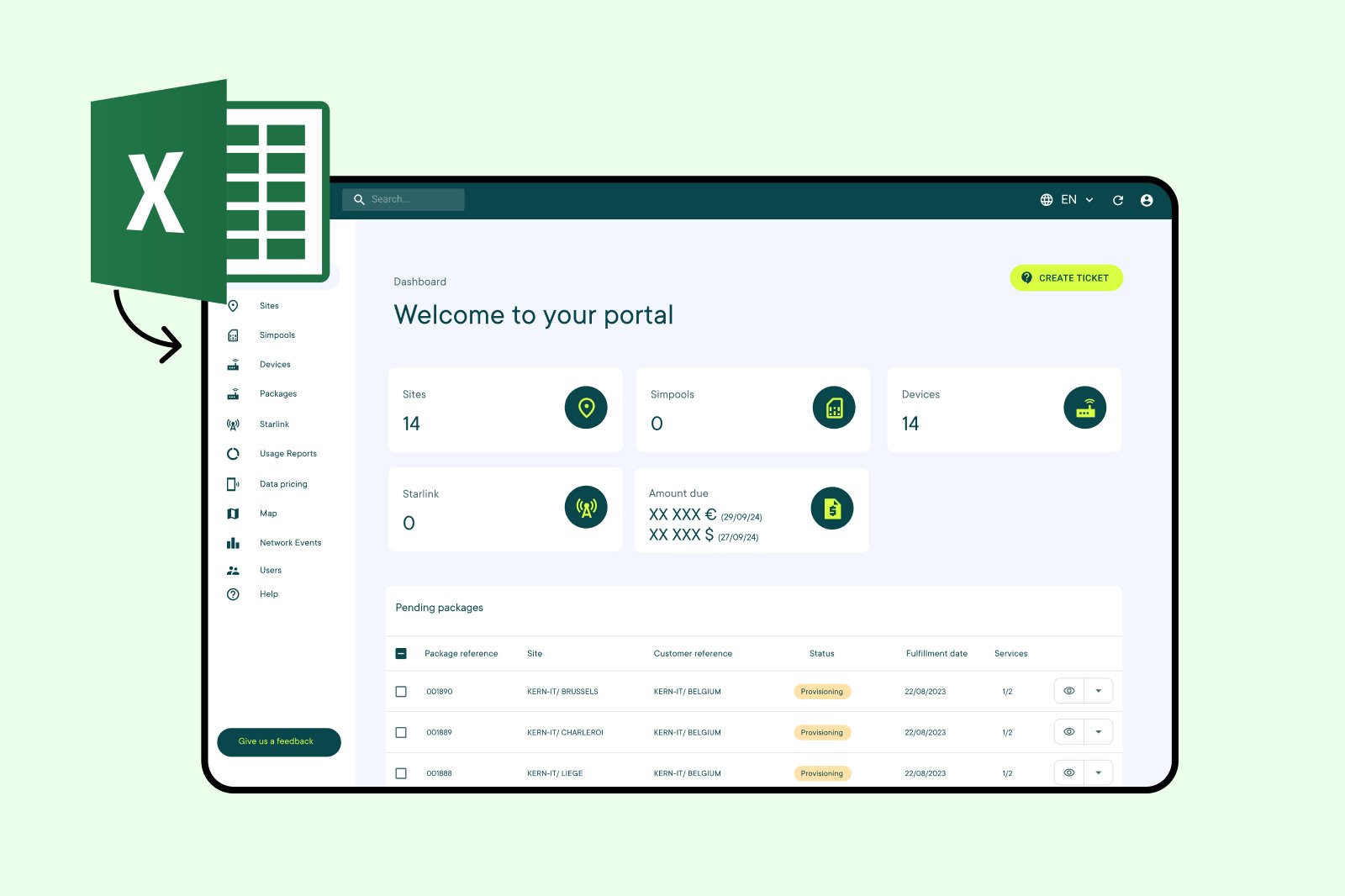
Conclusion: from spreadsheets to the digital core
Excel, Google Sheets, or Airtable allowed your business to grow.
They helped you understand your processes and your data.
But to reach the next level, you need a digital core: a central, robust, and connected system, capable of evolving brick by brick at the pace of your growth.
Digitalization isn’t about more technology.
It’s about giving your organization a heart capable of thinking, learning, and growing.
Still managing your operations in a spreadsheet?
This is probably the right time to talk.
We’d be delighted to help you transform that foundation into a true digital engine.